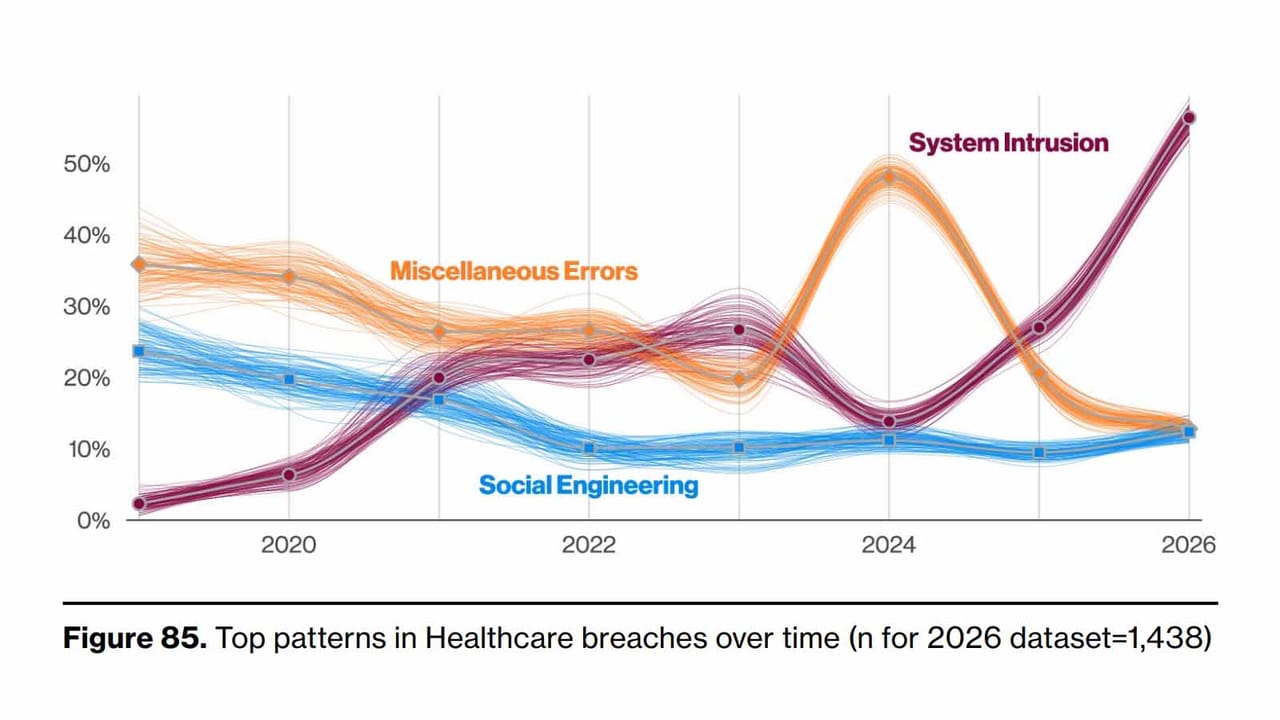
Verizon's 2026 Data Breach Investigations Report reveals that healthcare organizations face escalating social engineering attacks alongside persistent ransomware threats and vendor compromises. The sector confronts a multi-layered attack surface combining human manipulation with technical exploitation.
Social engineering tactics against healthcare have grown more sophisticated and targeted. Attackers increasingly craft personalized phishing campaigns and pretexting schemes that exploit the sector's trust-based culture and high-pressure environments. Healthcare workers, often stretched thin operationally, become prime targets for credential theft and unauthorized access.
Ransomware remains entrenched in healthcare environments. Threat actors deploy encryption-based attacks that directly threaten patient care by disrupting clinical operations and forcing difficult triage decisions between paying ransom demands and maintaining service delivery. The sector's dependence on continuous system availability gives attackers significant leverage.
Vendor compromise presents a third attack vector. Healthcare organizations rely on external software providers, medical device manufacturers, and IT contractors. When these vendors suffer breaches, their access privileges can cascade compromises across dozens of downstream healthcare entities. Supply chain attacks against healthcare vendors have proven particularly effective.
The report emphasizes that healthcare's technical defenses alone cannot counter this threat landscape. Human-centered security becomes essential. Organizations must invest in employee security awareness training that addresses healthcare-specific attack scenarios. Credential management practices require hardening, including multifactor authentication deployment and privileged access controls.
Detection capability gaps persist. Healthcare organizations frequently lack the monitoring infrastructure to identify compromised credentials or lateral movement across networks. Early breach detection, critical for limiting ransomware impact, remains inconsistent across the sector.
Healthcare's constrained IT budgets and clinical priorities often defer security investments. However, the 2026 report demonstrates that social engineering, ransomware, and vendor risks have matured into existential threats to care delivery. Organizations must balance operational demands with security fundamentals, including