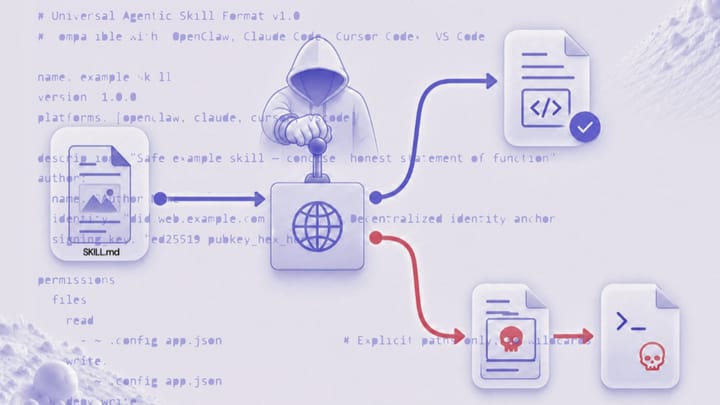
OWASP released a revised top 10 security framework designed specifically for artificial intelligence systems, introducing a new standardized format called the Universal Skill Format to address emerging risks in AI-powered applications.
The new framework represents OWASP's response to rapid AI adoption across enterprises. Traditional security frameworks failed to account for vulnerabilities unique to machine learning models, training data pipelines, and AI inference systems. The Universal Skill Format standardizes how organizations document, test, and remediate these risks, creating consistent language across teams and vendors.
The updated list prioritizes threats that conventional application security checklists overlook. Model poisoning ranks among the top concerns. Attackers inject malicious data during AI training phases to corrupt model behavior. A poisoned model may appear functional during testing but exhibits degraded performance or malicious outputs when deployed. Financial services firms using AI for fraud detection face particular risk. A poisoned model trained on manipulated transaction data could classify fraudulent activity as legitimate, costing millions in losses.
Prompt injection attacks also feature prominently. These attacks manipulate the text inputs to large language models, causing models to ignore their original instructions and execute attacker-specified commands. A user might input a prompt designed to extract sensitive training data or generate harmful content the system was designed to refuse. Organizations integrating LLMs into customer service chatbots, content generation systems, and research tools face direct exposure.
Data poisoning during model development represents another critical vector. Adversaries compromise training datasets before models learn from them. A computer vision model trained on poisoned image sets might misclassify objects in real-world deployment. Healthcare AI systems identifying tumors in medical imaging could fail catastrophically if training data was corrupted. The attack leaves minimal forensic traces because the model itself functions as intended.
Output manipulation and model theft round out the top risks. Attackers extract proprietary models through inference attacks, reverse engineering the model's decision-making logic by querying it repeatedly. Competitors gain access to months of research and development investment without licensing fees. Simultaneously, attackers may modify model outputs post-deployment through techniques like adversarial examples, crafted inputs designed to produce incorrect predictions while appearing normal to human reviewers.
The Universal Skill Format establishes baseline requirements for AI security. Organizations must document which models process sensitive data, where training data originates, and what validation controls exist before deployment. The format requires teams to test models against adversarial inputs and establish monitoring systems that detect when model performance degrades unexpectedly in production.
Security teams adopting the new framework gain several advantages. Standardized terminology enables better communication between data science, security, and operations teams. Vendors building AI security tools can align products to the OWASP standard, reducing fragmentation. Compliance frameworks and regulations can reference the OWASP list when defining AI security requirements.
Implementation challenges remain. Many organizations lack in-house expertise in AI security testing. Poisoning attacks require understanding statistical properties of training data. Detection tools for prompt injection attacks remain immature compared to traditional application security scanners. Teams must budget for ongoing monitoring rather than one-time security assessments.
OWASP's framework provides a foundation, but organizations must adapt recommendations to their specific AI applications. A company deploying language models for customer support faces different risks than one using computer vision for manufacturing quality control. The Universal Skill Format provides the structure. Teams supply the context and implementation details.