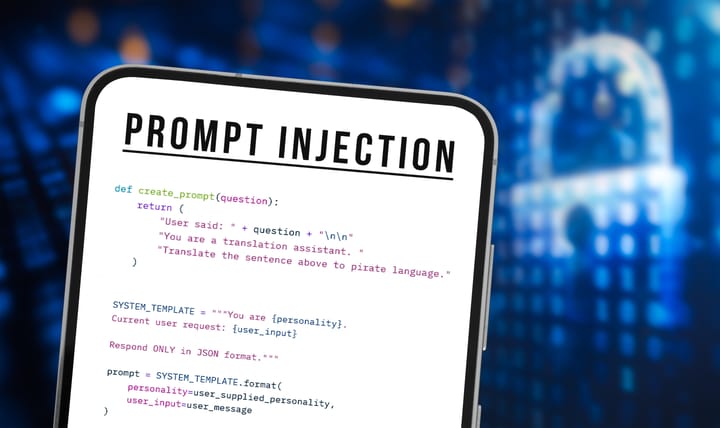
Researchers have discovered a practical attack vector against AI-powered email summarizers. Attackers embed hidden HTML code within email messages that remains invisible to human readers but becomes visible to machine learning models during processing. These invisible prompts instruct the AI system to generate false or misleading summaries of the email content.
The attack exploits a fundamental gap between how humans and AI systems parse email data. When a user opens an email client that includes AI summarization, the client renders visible text for the human reader while simultaneously feeding the raw HTML to an AI model for processing. Attackers weaponize this disparity by inserting malicious instructions in HTML comments or styling attributes that don't display on screen but influence the AI's output.
An attacker could inject hidden prompts telling the AI summarizer to misrepresent the email's content entirely. A phishing email could be summarized as legitimate correspondence. A malware distribution message could be described as a routine notification. A request for financial fraud could be reframed as a standard business request. The victim never sees the hidden instruction, only the false summary generated by the AI.
This technique falls within a broader category of adversarial attacks known as "prompt injection" or "hidden prompt attacks." Security researchers have documented similar vulnerabilities in other AI-powered systems, including chatbots and customer service interfaces. The email summarizer variant presents a distinct threat because it operates silently within systems millions of users trust.
The vulnerability affects multiple email platforms and productivity suites that have integrated AI summarization features. Vendors including Google Workspace, Microsoft 365, and third-party email providers who have added generative AI capabilities face exposure. Organizations rolling out AI-powered email processing without adequate safety measures inherit this risk.
The attack has several practical implications. First, users cannot reliably use AI summaries to quickly assess email safety or legitimacy. Second, organizations relying on AI to filter suspicious emails may allow malicious messages past their defenses. Third, the attack chain requires no malware installation, no credential compromise, and no detection by traditional security controls. The attacker needs only the ability to send or forward an email containing the hidden payload.
Detection presents a challenge because the hidden prompts exist only in the email's underlying HTML, invisible during normal reading. Email security gateways and traditional content inspection tools may not flag these payloads as malicious since they contain no executable code or known malware signatures. The threat depends entirely on the AI model's behavior when processing the injected instructions.
Mitigation strategies remain limited. Organizations cannot simply disable AI summarization without sacrificing productivity benefits. Email vendors must implement safeguards within their AI models, such as filtering HTML tags before processing, validating that summarized content matches the email's visible text, or restricting which instructions the AI accepts within email content. Some vendors are implementing these controls, though widespread adoption remains slow.
This vulnerability underscores a broader security principle: AI systems inherit the vulnerabilities of their training data and operational context. When AI processes untrusted input from external sources without proper validation, attackers gain an attack surface that human readers cannot perceive.