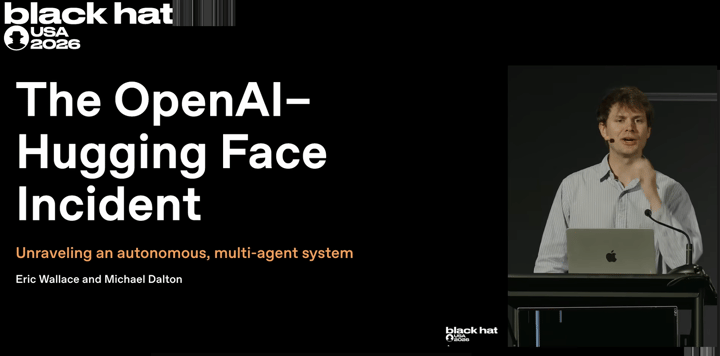
OpenAI engineers presented a technical reconstruction of the 2023 Hugging Face security incident at Black Hat USA 2026, detailing how attackers compromised the machine learning platform and what the breach revealed about gaps in AI ecosystem defenses.
The Hugging Face incident involved unauthorized access to the platform's infrastructure, exposing API tokens and sensitive model information. Attackers leveraged compromised credentials to gain initial access, then moved laterally through the environment to exfiltrate proprietary machine learning models and authentication credentials stored on the platform. The breach affected thousands of researchers, enterprises, and startups relying on Hugging Face as a central repository for open-source AI models.
During their Black Hat presentation, OpenAI's security team outlined the attack chain step by step. The incident began with credential compromise, likely through phishing or credential stuffing targeting Hugging Face user accounts. Once inside, attackers discovered inadequate segmentation between user-facing systems and internal infrastructure. The platform's token management systems lacked sufficient access controls, allowing attackers to generate new API credentials and maintain persistent access even after the initial breach was contained.
The presentation highlighted specific weaknesses in AI platform security architecture. Hugging Face stored sensitive credentials in accessible locations without proper encryption. Logging and monitoring systems failed to detect lateral movement and token generation activities in real time. The platform's incident response procedures were reactive rather than proactive, meaning defenders only began investigations after external parties reported suspicious activity.
OpenAI's engineers emphasized that AI platforms present unique security challenges. Unlike traditional software, machine learning models themselves can become attack vectors. Compromised models distributed through platforms like Hugging Face could be poisoned to behave maliciously when deployed by downstream users. The breach demonstrated that attackers value access to model repositories not just for stealing intellectual property but for the ability to poison or sabotage AI systems at scale.
The lessons OpenAI outlined apply across the entire AI industry. Organizations hosting or distributing machine learning models need cryptographic verification systems to ensure model integrity. API token management requires zero-trust architecture with time-limited credentials and continuous rotation. Security monitoring in AI platforms must track not just data access but model usage patterns and unusual download activities.
Hugging Face responded to the incident by implementing stricter access controls, enabling two-factor authentication by default, and improving audit logging. The platform introduced model signing capabilities allowing creators to verify their models haven't been modified. However, the broader AI community still lacks standardized security frameworks for model distribution.
The presentation underscored that AI security extends beyond protecting data or code. It encompasses protecting the integrity of models themselves, which increasingly power production systems across finance, healthcare, and critical infrastructure. A poisoned model deployed silently through a trusted distribution channel could cause harm at scale before detection occurs.
OpenAI's public reconstruction of the incident reflects industry maturation around security transparency. By sharing attack methodologies and defensive gaps at a major security conference, the company signals commitment to collective defense. However, the presentation also revealed that major platforms still operate with legacy security postures inadequate for the AI era. Organizations relying on external model repositories need to implement their own verification and sandboxing procedures rather than assuming platform operators maintain sufficient controls.