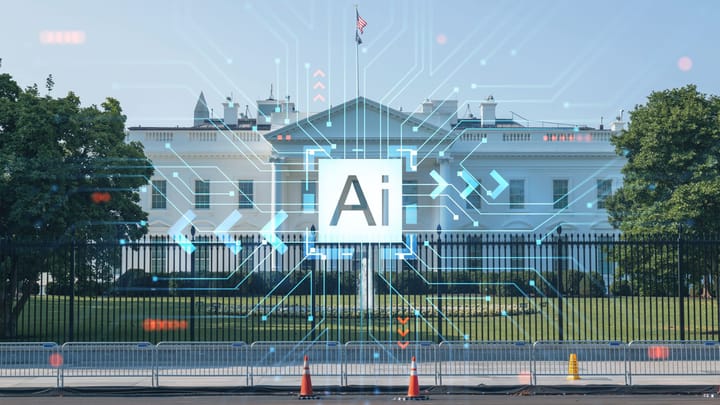
The White House reached a voluntary agreement with major technology companies to establish safety guardrails for advanced artificial intelligence systems, marking the first coordinated effort between the Trump administration and tech industry leaders on AI governance.
The accord, centered on what officials term "Super Intelligence," requires participating companies to implement enhanced controls, monitoring, and oversight mechanisms for large-scale AI models. The agreement stops short of mandatory regulation but establishes commitments that companies must meet or risk reputational and regulatory pressure.
Participating tech giants include OpenAI, Google, Microsoft, Amazon, Meta, and Anthropic. These firms represent the dominant players in large language models and generative AI infrastructure. The voluntary framework avoids the legislative pathway that characterized earlier Biden-era AI governance proposals, reflecting the Trump administration's preference for industry self-regulation over statutory mandates.
The accord requires companies to conduct safety testing before deploying new AI models, establish clear protocols for identifying and reporting risks, and maintain audit trails documenting AI system behavior. Companies must also designate chief safety officers or equivalent roles responsible for overseeing compliance. The framework emphasizes transparency, requiring firms to document their safety procedures for government review.
Specific commitments include red-teaming exercises where security researchers intentionally attempt to break AI systems before public release. Companies must also implement safeguards against model misuse, such as preventing deployment for creating biological weapons, large-scale fraud, or autonomous cyberattacks. The accord addresses risks from both malicious actors and unintended AI behavior that could cause widespread harm.
The agreement notably excludes binding enforcement mechanisms. Instead, the White House indicated that companies failing to meet commitments would face increased regulatory scrutiny and potential inclusion in future mandatory rules. This carrot-and-stick approach appeals to tech companies eager to avoid legislation while positioning themselves as responsible actors.
Industry representatives framed the accord as reasonable, arguing that self-regulation enables faster iteration and innovation than statutory frameworks. Some companies have already invested heavily in AI safety research, making the accord's requirements relatively aligned with existing practices. OpenAI and Anthropic, both safety-focused startups, view the accord as validating their approach.
Critics from security and policy communities expressed skepticism about the accord's enforceability. Without penalties for non-compliance or independent verification of safety claims, companies face limited consequences for violations. Researchers worry that voluntary agreements historically underdeliver on safety outcomes, with firms deprioritizing security measures when facing competitive pressure.
The accord creates reporting pathways for security researchers and government agencies to flag AI safety concerns. Companies must investigate substantiated reports within defined timeframes and disclose findings to relevant authorities. This mirrors responsible vulnerability disclosure practices in cybersecurity but applies them to AI system safety rather than code-level flaws.
International implications remain unclear. The accord applies only to companies operating in the U.S. market, but most signatories maintain global operations. Foreign governments and competitors may view the voluntary U.S. framework skeptically, potentially accelerating their own mandatory AI regulations. The European Union's AI Act already establishes binding requirements for high-risk AI systems, creating regulatory fragmentation.
The accord represents a pragmatic first step balancing innovation and safety but leaves core questions unresolved. Without enforcement teeth, compliance largely depends on company goodwill and market reputation. Future iterations may incorporate mandatory audits, independent oversight bodies, or graduated penalties for non-compliance.